





Karina: Welcome to the Landscape Ontario Podcast. I’m your host, Karina Sinclair, and today we’re talking about something that sits at the heart of every successful landscape project: trust. Unlike many purchases, clients are often investing significant money into something they don’t fully understand. They rely on their landscaper’s expertise to make decisions about design, drainage, grading, materials, plant selection, construction methods, and long-term maintenance.
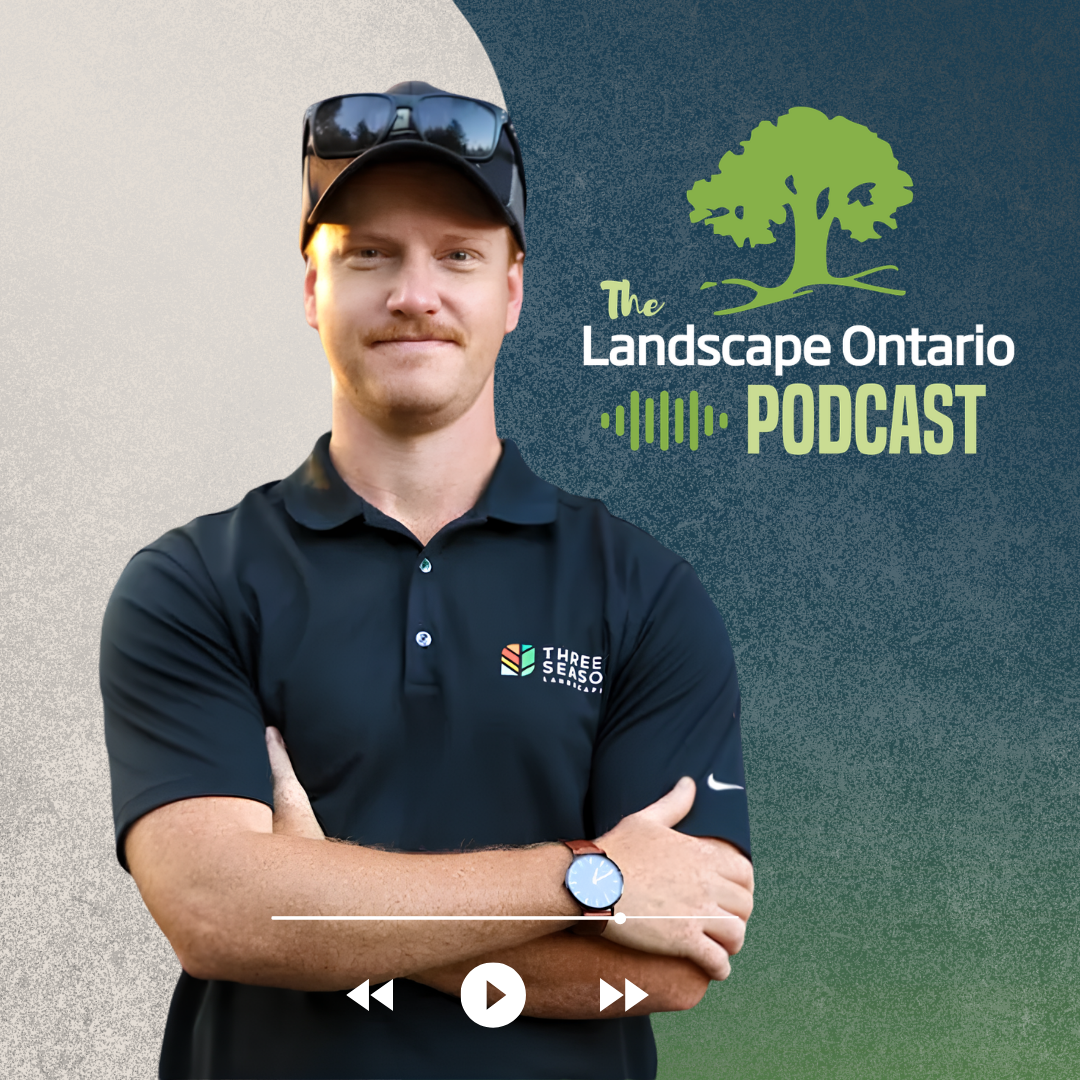
Much of the work’s value is hidden beneath the surface or won’t be fully realized until years later. If clients don’t trust their contractor, they’re less likely to accept recommendations, approve budgets, feel confident in the process, or give referrals. In this episode, I’m joined by Chris Hopkins, director and project manager with Three Seasons Landscapes, an award-winning full service business and certified Ontario living wage employer based out of Hamilton, Ontario.
Chris and his team spend a lot of time not just building landscapes, but helping clients understand what goes into them, often uncovering challenges and opportunities that aren’t obvious at first glance. We’ll explore how strong client relationships are built, why education is such a critical part of the process, and how experienced landscapers can help clients see the real value behind professional work.
Let’s get into that conversation with Chris Hopkins.
Welcome to The Landscape Ontario podcast, Chris. Thanks so much for taking the time to come and chat with us today about all kinds of things, but especially building trust and helping educate clients. So, uh, thanks again for making time and, and for being here today.
Chris Hopkins: Yeah, thanks for having me. I’m excited.
Karina: Well, let’s start by having you tell me about yourself, your career in landscaping, and how you came to your role at Three Seasons Landscapes.
Chris Hopkins: Where do we start? So Three Seasons kind of came to fruition back when I was in high school. I’m 31 now, so that was obviously more than a couple years ago, probably more than I’d care to, care to talk about. It started one summer between grade 10 and grade 11. I had family that were also entrepreneurs and business owners in various industries, and I kind of said, “Hey, I’d, I’d rather work for myself for $10 an hour that summer than work for somebody else and maybe start growing it, seeing where it goes.”
Continued that for summers in high school, obviously just doing small construction projects, some maintenance things, nothing crazy, ’cause it was basically just myself and a pickup truck at that stage. By the time I was in college, I had four people working for me full-time while I was finishing my schooling.
Continued into another full-time job as an estimator and project coordinator, actually, for a commercial general contractor while running my business, so managing both of those things in evenings, weekends, kind of however I needed to make it work. And then fast-forward to 2018, I was excelling in my career there.
Business was excelling. It was definitely beyond the point of being able to do both, so obviously I had to make the decision at that stage, at those crossroads, to figure out which path I wanted to take and, and obviously I chose the landscape contractor business owner path. and we’ve been really focused on growth and building relationships and excelling in different markets and different avenues of construction from then until now.
Um, And in 2026, we’re a very successful business, I think. We have 35 to 40 employees depending on the time of year, most of which are full-time year-round. Our business today is comprised of roughly half of our capacity in mid- to large-size residential projects, so full backyards with pools, pool houses, pavilions, decks, you know, gas, electrical, the whole thing.
Um, and then the other half of our business is kind of mid- to large-size municipal and commercial projects. So we do a lot of stuff for pretty much every municipality around us in terms of play structures, public space projects, pedestrian bridges, um, and really anything in the municipal world that they need, we’re happy to help.
We also do a lot of private commercial projects for uh, private colleges, uh, public school boards, that type of thing as well.
Karina: Wow. So not only are you trying to build trust with the homeowner-type client, but you’re also working within that public space. Municipalities have a lot of very specific requirements and there’s a lot of red tape and so many cooks in that kitchen that all have their desire to leave their thumbprint on a project.
So that’s a wide scope of types of people that you’re trying to build relationships with.
Chris Hopkins: Luckily, with the municipalities, we’ve slowly built those relationships over the past, like, six to seven years, so we have a lot of repeat business from, from those people, and we’re able to be fortunate enough to work with the same project managers and same project teams over and over again, so we really understand or start to understand how each other operates.
And, you know, whether we’re approaching a detailed residential project, a high-profile, you know, public park project, and everything in between, we pride ourselves on bringing the same mentality to everything. Detail-oriented, over-communicative, you know, quality, making sure everything’s done properly, and really just, taking an education standpoint as well.
That’s obviously harder to do on the municipal front because you’re not really having to educate these people because they’re consultants, project managers, project coordinators, that type of thing. On the residential side, we always like to try to educate our clients as much as possible, really from day one of meeting them on site to, you know, the last day of the project and beyond with aftercare of what we did.
Karina: Okay, so let’s talk about that a little bit more. You know, the trust is, it’s not just a nice to have, it’s a pretty foundational requirement for every successful project, and you have to earn it, especially when you’re asking somebody to make a significant investment in their property, what are some of those things that your team does early in the client relationship to build that confidence and credibility?
Chris Hopkins: I think it starts with even before we meet them. Most of our clients, especially on the private residential side these days, are 95% referral-based. So we’ve probably worked for their neighbour, a family member, a friend, um, a, a close-by project that they’ve walked past, you know, during their evening walks and seen our work maybe even taking shape.
Right away when they contact us, there’s kind of a mutual understanding that they’re not just looking for a price. They’re not just looking to have something done. They’re looking to have a certain experience, and that’s been referred to them from other work that we’ve done. So right away they kinda know what to expect from us, and we know what we have to provide to meet their expectations and to meet our own expectations of that experience.
From the first second that we step on site for initial consultation, we’re talking about all the right things in terms of like, you know, desired goals, how long are they planning to be in the house? Do they have a budget range? If not, you know, what are some of the things they’re hoping to do so we can kinda start to establish that budget range, come up with different options for phasing the project because it’s not realistic for everybody to dump a whole bunch of money at one time into their property.
Sometimes for select clients or select properties, it’s better to do that over the course of a few years, as long as we have a really defined plan at the start, and then we can start chipping away at the proper things in the proper sequencing. One thing we’re really good at, that I think helps build a lot of trust is we have a, a really vast construction knowledge, not just landscaping knowledge, but I’m talking about, you know, municipal drainage codes and bylaws and setback requirements and just when we’re building something for somebody, even in the initial, design stages or consultation stages, we’re really trying to visualize that end result and if there’s gonna be any negative impacts to the neighbours, to their house, to their property from what the homeowners are trying to do.
We’re not afraid to tell people nicely that, “Hey, your ideas are great, but we don’t think that’s gonna work in this backyard. Here’s reason A and B. Alternatively, we can probably do this or that, which might be better for this or that reason.” So having like a full home health approach, if you wanna call it that, I think really helps gain trust because clients are getting questions answered that they didn’t even really know that they had or, or didn’t know they had to ask.
I think that just trickles down our entire process, being fully transparent, being open, being flexible from start to finish. I think they can really see that we’re never trying to hide anything. We’re never trying to cut corners. We’re trying to do things honestly and properly from, from stage one.
We’re not just gonna tell somebody they can do something because that’s what they wanna hear. We’re gonna tell them the honest truth and give them proper guidance, education, and, and feedback throughout the whole process.
Karina: You mentioned that a lot of business comes to you because people have already seen your work and/or have heard and gotten referrals from others who are happy with your work, and that’s a pretty powerful marketing opportunity. Maybe even more so than any money that you could put into, like, Google Ads or, or, you know, having posts online, things like that.
But you really have to be on it every single step of the way because one misstep in building that trust at any point in the project’s process could, could really take you backwards. So, like, that, that requires a lot of dedication to making sure that everything is clear and concise and, like you said, over-communicated every single step of the way.
Chris Hopkins: Yeah, and that’s definitely what’s helped us be successful and continue to be or continue to grow success within our business. But the way I look at it, coming from a construction background and just the level of projects that we’re building and the clients that we’re working with, there’s no other way to do it.
Like, I, I try to put myself in the client’s shoes from the onset of, of communication with them, and I couldn’t imagine having a contractor that you might not really know working in your backyard for five, six, seven months or more, in a neighbourhood where you care about your neighbours, you have relationships with your neighbours, you want it to be a good image and representation of your family and what your family is doing to the home.
If the whole process isn’t over-communicated and you don’t understand exactly what the contractor’s doing, I couldn’t imagine working with any contractor that’s not doing that because like, you just have thousands of questions that you’re hoping you don’t have to ask or hoping the contractor’s thought of.
Whereas for us, yeah, there’s probably lots of emails going out to the client, but that’s just so they never have a question. We’re answering those things before they even know they need to ask it. Here’s the plan for the day. Here’s the plan for tomorrow and two days from now. Here’s an update. Hey, we had a half rain day.
The electrician needs access into your house on Friday at two o’clock. Is that okay? Will somebody be home? Just all those things. And I think the over-communication stems into not just our experience with the clients, but that’s also what we expect from our teams on site.
So they get into that mentality. So now they’re over-communicating back to us as project managers and coordinators. So it’s just a big circle. And then what we find is the clients actually start over-communicating things to us, which is great because then they’re even messaging us being like, “Hey, yeah, my husband’s at work tomorrow from eight to two. Let me know if you need anything and I’ll change the schedule.” Whereas otherwise they wouldn’t even know to let us know that unless we’re kind of in that mentality of just being involved in, in each other’s world a hundred and ten percent from day one until the last day on site.
Karina: Is it overwhelming to deal with all of that information and, and have so many communications going back and forth at once?
Chris Hopkins: There’s some days where it’s not overwhelming, but there’s some days where there’s a lot going on, for sure. A lot of changes, a lot of things, a lot of moving parts every day. Like at any given time, from April until usually Christmas, we have anywhere from 15 to 20 projects on the go that are all at different stages and, and of different sizes.
Some are easier to communicate and coordinate than others, but that’s the nature of the game and myself and, and the team that I surround myself with does an excellent job of it, and we stay on top of it. I think the key is just to be organized. If, if you know that you need to send a client an update at the end of the day, add it to your list for that day, add it to your task board.
Don’t go home until that’s done. And if you can’t send it to them, make sure you’re emailing them saying, “Hey, sorry, I’ve had a busy day. There’s a few changes. I need until tomorrow morning to send this because of this, that or the other,” so then at least they know to expect it tomorrow, not just that it’s not getting sent because then again, they have a question of like, “Oh, why didn’t this get sent? Did he forget it?” So it’s, it’s over-communicating even when you can’t communicate properly. There’s definitely challenges at different times of the year, for sure.
Karina: You mentioned that you have a crew of about 35, uh, year-round. For those companies or businesses that are a little bit smaller, maybe they don’t have as many employees, um, and like as you grew your business, how did you manage that when you didn’t have perhaps as much support staff as you do now?
Chris Hopkins: You know, it’s cliché and everybody, especially in the landscape industry, talks about it these days. Like, you know, you’ll hear the word processes, the word systems a lot. And I think a lot of people like to talk about that without really knowing what that means. But we’ve done a pretty good job putting different processes, different systems in place the last five years, and by no means are we perfect.
We have 50 more things we should be working on. We just don’t have the time to do it properly because the winters go by so fast and before you know it, March 1st construction starts, you’re going till Christmas, like true winter is really only a couple months. And the overlap at each end, plus in the middle of that, we’re doing snow removal and, and snow and ice management services.
So, your downtime when you’re running somewhat lean, efficiently, everybody here has an important role. Your time to just work on those things is probably smaller than we’d like it to be. But I think, you know, advice for smaller companies that are looking to do things, maybe not the way that we do it ’cause everybody’s different, but just to do things properly, keep growing relationships with clients, gotta figure out what works for your team. A process or a system or an app or whatever for one company might not work for the other three or four companies. Just like the way we communicate with our clients might not work for the clients that everybody else works for. So it’s just finding that niche, finding what is gonna drive people to be efficient, what’s gonna drive people to have ownership in what they do, to care about it, and making sure that people in the office are on the exact same page as people in the field, and everybody there should be on the exact same page as the client.
I think it’s really important to at least communicate the timeframes of the project, if and when there’s any delays, if there’s any changes, if there’s anything that’s unforeseen. I think it’s so critical to communicate those things early on so that everybody knows about it, and you can work through it together.
I don’t think any client likes surprises, especially when the surprise is gonna have a, a dollars and cents impact. And even if it doesn’t have a dollars and cents impact, I find that clients are pretty reasonable to change designs on the fly, to change this, to change that, as long as you communicate the reason and you explain it to them.
Most of them could care less. They just wanna be in the know, but if you let them know why ahead of time and you go through some options, usually you can come to an agreement pretty quickly.
Karina: Earlier when you mentioned that your crew has a really good construction background, and, you know, knowing those municipal setbacks and all those requirements, what are some things that homeowners don’t necessarily know about but you notice as a landscaper, a professional landscaper, coming onto a site for the first time?
Chris Hopkins: I think there’s, there’s a few things. The first and foremost is always drainage, especially because working in a lot of homes these days, properties are getting smaller and smaller. You know, a typical suburban home is no longer, you know, a massive lot, in the suburbs.
It’s probably a very small lot in a condensed neighbourhood. So anything that you do, anything your neighbours do doesn’t necessarily just affect you and the neighbour. It could potentially affect the entire survey or the entire row of townhouses or the entire row of semi-detached houses. So drainage is the first one.
The reason I say that is because you don’t wanna drain water onto your neighbours. You don’t wanna impact or, or go against any municipal bylaws ’cause that could be a problem down the road. But the other reason is when you’re thinking about drainage, you’re automatically thinking about potential grade differences in the property.
So if the backyard is a blank slate and it slopes from the back, you know, back of the house down to the fence line, if I’m thinking about proper drainage, I’m kinda thinking that, I can’t build a patio right up to the fence and I have to stay a certain amount back, which means, you know, if the patio has to be somewhat level, now I need a retaining wall.
So if I’m thinking about drainage when I walk on the site, that automatically means that I’m thinking about other costs, time and work implications like the need for retaining walls around a patio, like proper, you know, planting placement of trees and privacy and those things.
Like the, the biggest thing that we see is we go into a row house, right? In a town home or a semi-detached in a newer development, and everybody always wants the biggest patio possible and they want privacy because there’s no trees that are in the neighbourhood. They want columnar trees to block out their neighbours. So right away they want a patio that’s basically fence to fence that goes all the way back, and there’s usually a swale back there, and they want trees right back there.
Well, one, you can’t put the trees in the swale because the swale has to be maintained and the trees would probably die from all the moisture. So right away we’re five or so feet off the back fence line that we can’t work in, so now the trees are here. We can’t build our patio right to the fence. You need to stay at least a foot off in most municipalities, not just for drainage patterns, but also for proper granular over base under your, your patio and your edging. You can’t go right up to the wooden fence.
So a homeowner might have a vision pre-meeting with us of what they’re hoping for, but we kinda need to squash that a little bit unfortunately to say, “Hey, this is the realism of the space that we can work within. Does that affect your goals? Do you wanna look at some other ideas now?” And just kinda talk through those processes.
Karina: Yeah, there are a lot of those hidden elements that, you know, we don’t think about when we’re trying to design a visual product and all that underground infrastructure and, and those setbacks, th- those really make a lot of decisions for us.
Chris Hopkins: For sure, and that’s where clients might have awesome ideas because, I mean, hey, they’re the ones that live in the space. They’re gonna be the ones that are enjoying it, hopefully for decades to come. But it’s just about educating them on what’s feasible, what makes sense, and how to work all that into their budget, their timeline goals, everything else.
Figure out products that are gonna work for that, and I think we do a pretty good job of, of kind of na- navigating all those different constraints.
Karina: So let’s talk about constraints and maybe some projects that you’ve worked on. Have you ever inherited a project where a client had had a bad experience with another contractor and how did you go about rebuilding their trust and showing them what it’s like to work with a professional landscaping company?
Chris Hopkins: I don’t want to say every client we work for but I’d say a significant amount of clients that we work for have had some sort of poor experience with a contractor in their lifetime. That’s not to say it’s a landscape contractor. It could be a guy that did their bathroom five years ago or when they had their kitchen done 10 years ago.
I notice from meeting with people and talking to them about these things is that those experiences stick with them for a long time. Like, the husband and wife will be talking about a bad experience they had with a kitchen guy, and while they’re talking, in my mind, I’m kinda like, “Oh, okay, this must’ve been, like, a year ago or two years ago,” and it’s, like, 30 years ago.
So, that poor experience sticks with them for a long time. Even if, you know, the kitchen, for example, is still in great shape, and it looks really nice, and it’s functional, the poor experience typically outweighs the good things that come with the end result. So for us, having those experiences, meeting with clients and even just how we operate as a business, the process has to be as good or better than the end result ’cause, you know, the proof is talking to people, and they hold onto grudges for a long time.
And, if the end result’s awesome, that’s, that’s great. Maybe you’ll get paid. You know, maybe there’s no warranty issue, and it’s all good. But if the process getting there sucked, that’s all the client’s ever gonna remember. That’s all they’re ever gonna talk about. And no matter how much they love the nice pool you put in, every time they go out there, they’re gonna think about the terrible relationship they built and the terrible time they had just getting the project done.
So we try to eliminate those things for every client, especially if they’ve had a bad experience with a contractor, whether it was a year ago or three decades ago. And we try to find out what those things are so that we can really hone in on, on parts of the project that the client really cares about.
And we try to hone in on every aspect, but if the client really is worried about their basement because it used to leak, but it got fixed, but they don’t want it to leak again, we’ll spend a lot of extra effort there, even if not physical effort, communicative efforts and investigative efforts just so they have peace of mind that we’re doing things properly.
We take extra photos. We fix things. We’ll let them know about things. We’ll have them out to look at things during the project, and then when it’s sealed up and it’s done, they’ll never have a question in their mind if that basement’s gonna leak again. Even if it leaks in 30 years from now, they’re never gonna come back to us and say, “Ooh, yeah, these guys didn’t do something properly.” They’re gonna say, “Yeah, I was out there with the contractor the whole time. They did this. They did this. There’s no way it could be coming from that side of the house because I saw physically what they did.”
And I think that’s really, really important is figuring out those trigger points and those past poor experiences with clients so that you can make sure you’re hitting those especially out of the park. Not just to develop a relationship for yourself, but to advocate for the trades and contractors in general, to try to build back a good name for all contractors hopefully.
Karina: It sounds like communication and, and that thoughtful consideration of, of all their worries is really what separates a good landscape company from a great one.
Chris Hopkins: I think there’s lots of good landscape companies that build quality projects, that have good guys, maybe a good designer. But a great landscape company and a great anything company, whether it’s construction, retail, restaurant, whatever, goes above and beyond, not just in specific circumstances, but their mentality is to always go above and beyond because that’s just the way they operate to make sure that all of those things are, are taken care of and a client has a really, really good experience.
Karina: So what are some misconceptions that you think homeowners have about these landscape projects, and how do you educate them and, and guide them towards the right solution without making them feel like they’re being upsold?
Chris Hopkins: I think some misconceptions, you know, from somebody that’s never done landscaping before, I think they come into it, one, potentially not knowing the cost because they’ve never done something like that, which is fair. But I find the, the bigger one, ’cause the cost you can kind of talk to them about, you can go through phasing options, some budgets, you can kind of get everybody on board.
But it’s– I think it’s the timeframe. You know, a lot of people these days love HGTV, I get it, DIY Network, TikToks or Instagram reels with drone footage and time lapses, and they’re scrolling at night, and they watch a whole backyard get built in 15 seconds, and they’re like, “Oh, I love that.” And then not that they’re expecting your projects to get built in 15 seconds, but I don’t think they understand that the amount of in-ground work, the prep work, the utility trenching, permits, applications, the engineer dr- like the whole thing on a, on a large scale project, from the day you start on site to the day that you’re done, depending on the scope, could be six months, eight months.
It could be an entire nice weather season for a client. So if, if they’re pre-planning and you’re starting these conversations, let’s say now in June for a project that’s gonna start next March, sure, that’s lots of time to plan, but if the project’s gonna take seven or eight months to build, even if we start as soon as we can in March, that’s most of, most of the year gone, right? And you’re finishing in the fall. So they’re gonna actually really be enjoying it the next year after that.
And I think that’s just some of the misconceptions is that all this stuff just happens really, really fast, and, and it doesn’t. It’s methodical. It’s thought out. You have to do things in proper sequencing, proper timing, and yeah, there’s a time and a place in certain projects to just blitz stuff off with extra labour, but rarely does that typically impact the project timeline a lot.
Karina: You mentioned those reels, TikTok, uh, home and garden networks, and, I’m also finding AI really seems to be influencing people and the decisions that they wanna make with their backyards.
Chris Hopkins: Yeah
Karina: Recently I was at a garden centre, like a nursery, as a master gardener, and we do these clinics where people can come and ask us questions and get advice.
And a number of people come up to us with a printout in their hand and say, “ChatGPT told me that these are good plants for my garden.”
Chris Hopkins: Yeah.
Karina: And then I’ll look at them, and it’ll be, gosh, it’ll be plants that love water and plants that are drought tolerant in the same bed together.
And we, we have to do a lot of like, “No, no, no, this is, this is not really what you want. ChatGPT can’t see your backyard to know that this is not a good idea.” So there’s, there’s so much content and information out there that’s not helpful, and I guess you’re, you’re constantly having to repair that.
Chris Hopkins: I think in some ways it’s, it’s great because it now gives homeowners the ability to probably do a little bit more research on their end, or at least, aesthetical research of like, what’s it gonna look like? Let me take a photo of my yard and get ChatGPT to, you know, come up with some renderings. And that’s sort of helpful because at least the client has sort of a vision of what they like and don’t like.
But what I find is they’re taking those things too literally, bringing those printouts to meetings and saying, “Yep, I already have a design done. Here you go.” And it’s like, well, no, the plants that you’re showing in here, one, actually don’t even exist, or two, are like, at a 20-year maturity level, or three, are from the States or whatever.
It’s a great thing if people are using it properly, which is like in addition to this, in addition to that, not instead of. If they do that, I think it can be helpful. But right now what we’re seeing is just an influx of, you know, people who are apparently landscape designers now after 10 minutes on ChatGPT, and it does get a little frustrating for sure.
I had a client yesterday, actually, great client, but, yeah, same thing. ChatGPT printout, “This is what we want. No problem. Just price this.” It’s like, well, we can’t just price this. This isn’t gonna work. And they don’t really understand that. So times are changing. You gotta evolve, but we’ll figure it out.
Karina: Mm-hmm. Yeah, it’s an interesting time to be in this business, and frustrating and fascinating at the same time.
Chris Hopkins: There’s a lot of things changing for the better and, and for worse with technology, especially in construction, and I think you gotta adapt and you gotta figure out what works for your clients, what works for your business, and, and kinda run with it.
Karina: So let’s talk about your clients a little bit more. Have you had any situations where you’ve gone on site and the client thinks that they need one thing, but you identify they actually need something else or can resolve a problem they didn’t even know they had?
Chris Hopkins: Yeah, I think that happens fairly often, even for the reasons that we just talked about with ChatGPT. I find that clients have a very 2D vision when they’re thinking of things that they want. You know, they look at their backyard and they just think, “Okay, I want this grass space into a hardscape space.”
So they’re just thinking patio, maybe some trees, some gardens. So they’re thinking very 2D. They’re not thinking with a 3D mindset or an elevation mindset. For the example I talked about earlier, in a lot of these newer developments, they want a patio, but they don’t realize their backyard has like two and a half feet of slope over, you know, twenty feet.
So it’s like, “Hey, we can do a patio, no problem, but we need a retaining wall around three sides of it. We can do columnar trees for privacy, no problem, but they’re gonna have to be five or six feet off the fence line because of the swale,” and all these other things. So we don’t like telling people no. We don’t like just saying, “No, no, no.” But we’re also definitely not the contractor, nor should anybody be the contractor that just says, “Yep, yep, no problem, no problem. Yep, no problem. We’ll do it. We’ll do it,” because it’s gonna come to light sooner or later that you can’t do it or you’re gonna do what they asked, and in two years they’re gonna wonder why the project’s failing and your answer better not be, “Well, that’s what you wanted us to do.”
if that’s your answer when a client comes back to you in a couple years with a concern, you shouldn’t be a contractor. You should have put the onus on yourself and your team to come up with a better solution to their problem at the, the start of everything so that you’re proposing proper solutions to, you know, solve their problems that they brought up to you in the first meeting, but also, like you said, solve problems that they didn’t even know that they had.
And we hold ourselves to a very high standard. Like if there’s any mistakes on our end that get made during a project or there’s a certain part in a project where it’s like, “Oh, we need a little wall at the back of this patio,” it’s like, “Oh, crap, yeah. You know what? That was an oversight on our end. We should have accounted for that when we shot our grades and we didn’t realize this or that.” If that’s the case, the client’s never gonna see a dollar or cent for that. To me, that’s on us to do, and the last thing I want is to bring up a change to the client that we should have thought about in the beginning.
We kind of hold ourselves to that standard so that our team operates the right way and our clients, you know, basically are still getting what was presented to them.
Karina: When we had a bit of a chat earlier, you were telling me about this one project where somebody had a retaining wall and it had been fixed a couple of times by other contractors, but didn’t actually resolve the true issues. Can you tell me a little bit about that experience?
Chris Hopkins: Yeah. So, super nice lady. We quoted a few options for her at different price points, and we were kinda going back and forth on budget, and it was a large investment for her, especially considering she’d actually redone the wall, I think, three times in the last, like, six or seven years. But again, she was going down the mentality of, “I need to do this for as cheap as possible again.”
I met her on site. I spent a couple hours with her reviewing the quote, literally walking through every single step of the project and what we were gonna do better, why we had to pull the fence down to do the wall properly, and we were gonna do geo-grid to tie it back and, you know, while the side of the house was exposed, we were gonna do some blue skin on the foundation and make sure there was no leaks and tie in the downspouts properly into wall drains and all this other stuff.
At the end of the meeting, she signed the contract, and the project’s booked in for September this year. I don’t fault her at all for that because I think she had been misled by previous contractors the last few years because maybe the contractor didn’t have a lot of education in what she was looking for and/or the contractor was trying to make a quick sale.
“No problem. This’ll fix it.” You know, “The previous contractor did a bad job. We just need to do it properly.” But, like, properly is a funny word, right? It’s like, what, what does that mean? Does it mean… Doing something properly, does it mean fixing what’s there and making it look good again, or does it mean taking it apart, figuring out why it failed, fixing it the way that it needs to be fixed in that specific scenario?
And the outcome of that is, yes, it looks good again, but it’s also gonna look good like that forever. To me, that’s what properly means. And yeah, she had just been totally misled, I think, and there were tons of drainage issues. The downspouts were flowing right into the back of the wall. There was no drainage material behind the wall.
I was happy that we were able to educate her and walk her through the process, and show her that we weren’t just rebuilding the wall. Like, this was a whole, this was a whole different ballgame that we were playing. And I’m fully confident that, yeah, it’s gonna be a great project, and she’s never gonna have to touch that wall again.
Karina: And this is one of those cases of the damage that inexperienced or fly-by-night contractors can do to an entire trade and, you know, putting somebody’s home at risk. I mean, people don’t put in retaining walls just for fun. I mean, there’s solid physical reasons why they need to be there.
And, you know, there, there could have been a lot of damage by not doing it right in the first place, and the amount of money she’s going to spend to get it done properly
Chris Hopkins: Yeah
Karina: is, you know, you consider how much it costs to get it done three or four times.
Chris Hopkins: Doing it three or four times is always more expensive than doing it right the first time. You know, case in point, you know, part of the project now we’re having to remove the fence because the wall’s pushing the fence over and has damaged it. Some of the concrete around her pool is cracked because the grade’s falling away, so that’s gonna have to get replaced.
I think contractors need to hold themselves to a high standard, and educate clients, but also be willing to draw the line. Like, for example, if this client didn’t want to do it the way that we were proposing, I wouldn’t have said, “Oh, okay, well, we can do it for thirty grand less, and we’ll just put it back as best as we can.”
I’d rather lose the project because I don’t want to be that next contractor that she’s talking about with somebody else in three years of why the wall failed. So I’d rather lose business versus not doing things properly. And I’m not trying to sell that as like a pitch to use our company at all, but just in general in construction, I think. It’s always a race to the bottom when it should be a race to the top and building each other up and educating people.
And I think some contractors are so afraid of not being able to keep their guys busy or downsizing or not being able to grow or whatever, and I, I don’t think, you know, all, all the stuff online and on Instagram and TikTok is not helping that ’cause every, every time you scroll your finger, it’s something about growing a business and cash flow and apps and processes and, you know, why you suck if you still work in your business every day and aren’t, like, sitting on the couch, you know, letting your guys do things.
And it’s– I don’t think that’s helping ’cause everybody sees failure, you know, even success, if it’s not to a certain level, everyone’s like, “Oh, well, there’s other people doing better than me.” And, you know, I th– yeah, it’s just a, it’s a by-product of, like, all those things mixed together. But I, I do think if contractors spent a bit more time educating clients and were willing to say there’s a line in the sand that they’re not willing to cross to just get the job, I think that would help build everybody up over the next five plus years, and we could be in a much better spot where clients know that it’s gonna cost them good money to do something because it’s gonna be done properly, and they don’t have to do it again in five years or ten years or think about it in thirty years from now when they hire somebody else to do a different type of work.
Karina: What are some of the other lines in the sand that you might have? Uh, I, I know some other contractors I’ve spoken to, like, if a client asks them to put landscape fabric in a garden bed, they will not do it. Uh, if they ask them to plant something that’s actually considered invasive, they will not do it. Uh, What are some of your lines in the sand that you’re like, “No, hard stop. Will not do this. Client’s not always right”?
Chris Hopkins: I think there’s a lot of them. I think the one you just said actually that I probably wouldn’t have thought of, but the fabric in the garden beds, that’s a funny one. All the time, it’s like, “Oh yeah, we don’t want any weeds.” It’s like, “Okay, well, what’s gonna happen if you put fabric in your garden bed and then a few inches of mulch on top? What, what do you think’s gonna happen after a couple rainfalls? All, all that mulch is gonna be on your grass, and then you’re gonna be calling me back saying, ‘What’s going on?'” So yeah, that’s definitely one. I don’t think we’ve ever put fabric in garden beds, and when people ask, we’re just like, “We, we just don’t do this. This is not proper.” Definitely that one.
And, how we can use concrete and how we shouldn’t use concrete in our climate in Southern Ontario and in Canada with freeze-thaw. I think it’s, it’s just being real with the wear and tear that things are gonna take.
So if a client wants to spend, you know, five times the price of a normal driveway paver on a certain one that has a crazy finish or a crazy colour or whatever, it’s like: Listen, this is a driveway. You’re gonna beat it up every day. We can make it look really good with a product that’s significantly less money because if we spend more money on this product, it does not mean longer duration of quality driveway. It does not mean a better driveway. You know, the product’s gonna fail in a few years, not the install or the product itself, but the finish on it, why you paid more for it. Or people that wanna do concrete in the driveways and think it’s gonna last forever. Like, listen, concrete’s gonna crack at some point. No matter how well it’s done, if you get minus 30 temperatures one week and two degrees in the week after over a course of a number of years, it’s gonna crack.
So it’s… Again, it’s about education. It’s steering people away from certain things. So definitely a line in the sand for us is what we build driveways with and how we build it.
We make sure we do a full excavation underneath every time. Six inches of two-inch crush, a layer of geo-grid, six inches of three-quarter crush, sometimes even more. I think the line in the sand for sure is, like, the construction details, not just for driveways, but a lot of things.
If clients see that as a way to save money to do the same project, we’re not willing to change that because those are the bones and the heartbeat of everything that’s gonna make it last for a long time. We’re not cutting down on excavation. We’re not cutting down on granular base or different products.
If you wanna cut down on something to save budget, let’s make the area smaller. Let’s take out the nice-to-have outdoor kitchen or the nice-to-have lighting system and do that as a phase two. Like, let’s make sure what we are doing is done properly, and that you’re never gonna regret it. Or by the time you go to do another phase in two years, the first phase is already failing or needing touch-ups because we cut a bunch of corners.
So I think, yeah, line in the sand, if I had to pick three, it would definitely be fabric in, in the gardens. That’s a no-no. Construction details. In terms of, like, proper base, proper everything. And then the other one I think is, like, setbacks. We’re not gonna build a patio right to your fence boards. That’s just… That’s, that’s a no. Not only is it against most bylaws, that just means that then I can’t have proper over base. I can’t have proper edging with spikes, it’s gonna fail at some point, or the fence is gonna move differently in the patio.
So I think those are the three. It’s like setbacks, fabric in gardens, and just general construction details of, of everything. We’re not willing to change those.
There’s probably a bunch more too, but those ones come to mind.
Karina: And those are all relatively invisible elements.
Chris Hopkins: Yeah.
Karina: Nobody sees how deep the crush goes under a pathway. Nobody sees drainage. Nobody, because what they’re imagining walking into their yard or their property is everything above ground. But none of that is going to be successful unless you have all those invisible things in place.
So that does take a great deal of trust for a client to say, “I’m gonna give you many thousands of dollars to do invisible work. Oh, and then we’ll plant nice trees and shrubs and flowers.
Chris Hopkins: Yeah, exactly. And I always try to look at it like if you were doing a renovation inside your house, you’re not gonna spend two hundred grand on a nice kitchen, or you shouldn’t, if your roof is leaking, right? Or if your insulation is failing, or your gutters are dumping water into your basement.
Like, you’re not gonna finish your basement with a nice home movie theatre and a bar and all this stuff if every two days you gotta put a dehumidifier down there and suck out all the water that just came through the crack in the foundation.
So it’s like maybe let’s, let’s tone down the nice-to-haves a little bit if we need to. Let’s do things properly. You can always build on it in the future. So yeah, it’s, it’s kind of like a reference just to life in general, right? Like everything that’s good and proper and important is always not seen. Like, you know, the dig out of the granular base, the utilities, how you run the gas line, all those things. How you build your pools, the foundation for the pool house, like those things. The waterproofing on your, your foundation, the insulation in your attic.
You could have like the nicest renovation or nicest pavers, but if you don’t have any of those things taken care of that are gonna help that nice finish last forever, yeah, it might look good for a year, but then you’re gonna have to take it up. The stuff under the underground and that’s not seen is always the most important for sure.
Karina: Mm-hmm. Well, as somebody who’s replaced all the Poly B in our house and had a complete septic system rebuild, I am very familiar with all of those expenses that go with invisible things. But, you know, that’s, that’s adulting for you. Um, So if you could give some advice to those landscape professionals, those up-and-coming building their brand, building their reputation, what advice can you give them about establishing how they develop trust with their clients before the shovel ever hits the ground, before payment’s ever handed over? What can they do this week to start building trust with their clients?
Chris Hopkins: I think the first thing that they can do is make sure that they’re taking on the right clients. So don’t always say yes to everything. Don’t be afraid to say, “Hey, I don’t think that’s a good fit for us. We’re gonna respectfully pass.” There’s no shame in that, so that you can focus the time and the energy on the right things with the right clients.
For example, this week, let’s say a contractor has, I don’t know, 15 projects between their couple crews that they have to get done this week. Maybe they’re all small projects, but all 15 take a little bit of extra time than they thought, or the materials aren’t perfect, or 10 of the 15 have little issues on site that you don’t have time to figure out now because you’re managing so many things.
Wouldn’t it be better to do eight jobs at a higher profit percentage and those eight people are extremely, extremely happy? You’ve gone above and beyond for them, and those eight jobs probably just turned into 25 more over the next couple years than it is to do 15, you know, not very well. I think that’s an answer that most contractors need to look themselves in the mirror and, and figure out.
And hey, I, I still struggle with this. Everybody struggles with this. Like, you never wanna turn down what could be an opportunity, and sometimes it’s hard to enjoy building full projects because by the time you’re halfway done, yes, you’re still very much thinking about that project and over-communicating it to the clients and making sure it gets done well, but you’re also having to start that process with the next client that you booked in.
So if you can allow yourself a little bit more time to do things properly, communicate, make sure quality is upheld, processes, systems, like the whole thing, I think you’ll sleep better at night, and you’ll have a lot more, well-produced projects for really, really happy clients, and that will repay itself tenfold over the next few years for sure.
That would be an immediate thing that should be easy for everybody to do.
Karina: And I love that you mentioned the importance of being able to enjoy the project, right? You, you didn’t get into landscaping because you hate doing it. I mean, like, it, it’s, it’s something that you, you actually get a kick out of accomplishing, you know, seeing your, your end product and to be proud of it and to have time to appreciate what you’ve done before having to rush to the next, rush to the next.
Chris Hopkins: Yeah. And it’s, it’s really hard to do. I struggle with that all the time because I take pride in being organized. I take pride in things being done well and our teams being efficient and stuff, but that also means that at some point it’s shifting to the next project, to the next one, the next one.
And yeah, you get to the end of the year and you look back, you’re like, “Oh yeah, it was an awesome year. Look at all the stuff we built and the clients that are really happy,” But it’s hard to take a breath and really look at what you’re building on each one.
So it’s hard to always appreciate where you are as a contractor and not just project to project, but even as a whole. Like, I don’t think social media helps with that, but even the most successful people and, and myself on a very lower scale of that obviously compared to some people. But, it’s hard to appreciate where you are, for sure.
If I could go back in time and tell myself when I was 18 where I’d be today, I’d be like, “Oh, I won the fricking lottery. This is awesome. Like I’m, I’m done growing. This is amazing. This is the dream.” And then I f- I got us there, right? But it– you don’t really appreciate it that much ’cause you’re always thinking about the next step and the next step. So it’s hard to enjoy the moment or even the year or the month or whatever.
But if you can try to do that even a little bit as a business owner, I think you’re winning for sure.
Karina: I think that’s great advice, not just for landscape business owners, but for anybody who gets caught up in the daily grind and, you know, needs to just take that perspective and enjoy the moment. Yeah, we’re planning ahead. You’d be a fool not to, but the right here and now can be pretty great if you, if you wanna be aware of it, so.
Chris Hopkins: For sure.
Karina: So Chris, thank you so much for coming on to the podcast and sharing your experiences and reminding us that great landscaping is more than just plants, stone and construction. It’s about solving problems, earning trust and helping clients make those informed decisions. So I appreciate that you took the time out of your busy schedule to talk with us today.
Chris Hopkins: Absolutely. I really appreciate you having me, and, if anybody has any questions, they can definitely reach out to us online, and I’d be happy to uh, chat with anybody who just wants to have a chat.
Karina: That’s great. I’ll be sure to include the link to Three Seasons Landscapes in the show notes, and I think listeners will hopefully be inspired to make some shifts in their business operations and find more enjoyment while building those relationships with their clients.
Chris Hopkins: Awesome. Thank you very much.
Music
Karina: That wraps up our conversation with Chris Hopkins from Three Seasons Landscapes. A big thank you to Chris for sharing his experience and insights into what it really takes to build trust with clients and guide them through complex landscape decisions. If there’s one takeaway from today’s discussion, it’s that great landscaping isn’t just about what gets built.
It’s about communication, education, and relationships formed along the way. I’ve put links to Three Seasons Landscapes in the show notes, as well as a full transcription on this episode’s webpage at landscapeontario.com/podcast. Thank you so much for listening to the Landscape Ontario podcast. We hope you’ll subscribe to catch new episodes every month and share this episode with others who would benefit from the insights shared in today’s conversation.
Until next time, keep growing.