How a 36-year vision led to a world-class training centre for the landscape trades
In 1990, the Landscape Ontario (LO) Provincial Board of Directors tasked a committee of past presidents to chart the industry’s future by drafting the association’s first-ever strategic plan.
When discussion shifted toward a permanent headquarters, chair Casey van Maris asked the room to brainstorm, recording their ideas on a flip chart. As former LO executive director Tony DiGiovanni later recalled, that 20-minute session proved prophetic. The committee outlined a 50-acre home within 30 minutes of Toronto Pearson Airport, complete with continuing education classrooms, demonstration gardens, a research centre and an apprenticeship training school modelled after the Niagara Parks School of Horticulture.
“It was also envisioned as a central hub for allied green industry associations,” DiGiovanni said.
Four years later, the stars aligned when Shemin Nurseries put its 50-acre nursery site in Milton up for sale. LO member John van Wissen brought a copy of the 1990 strategic plan into the association office and urged LO to make an offer. The property checked every single box the past presidents had envisioned.
“Purchasing the Milton site made everything else possible,” DiGiovanni said.
“The opportunity was right and the board at the time had this incredible vision for this property to be a centre of excellence for training for landscape horticulture in the province,” said Joe Salemi, current LO executive director. “And I don’t know if they ever realized what that vision would look like 30 years later, but holy smokes, here we are!”
DECADES OF GROUNDWORK
 Throughout the next three decades, the association steadily expanded training at its Milton headquarters. In 1995, LO partnered with Human Resources Development Canada (HRSDC) to deliver a Youth Initiatives Program. Led by coordinator Terry Murphy, the program provided three months of intensive training to 50 unemployed young people, achieving a 100 per cent job-placement rate and sparking seven subsequent cohorts.
Between 2003 and 2005, LO teamed up with Humber College dean Bob Moulton to develop the Horticultural Training and Education Centre (HORTEC) proposal. While a $2-million provincial infrastructure grant was narrowly cancelled due to shifting provincial budgets, the partnership endured, establishing an on-site Horticultural Technician Apprenticeship delivery program by 2005. By 2019, modern classroom renovations and the launch of the GROW (Get Ready for Opportunities at Work) program under Sally Harvey solidified LO’s direct administration of apprenticeship and foundational skills training.
TAKING THE MOONSHOT
The long-held dream of an all-encompassing, purpose-built facility gained sudden momentum when the Ontario Ministry of Labour, Immigration, Training and Skills Development (MLITSD) unveiled the Capital Stream of the Skills Development Fund. The fund earmarked support covering up to 49 per cent of capital expenses for skilled trades training infrastructure. LO’s leadership recognized a transformative, once-in-a-generation moment for the entire green industry.
“We had a long conversation internally about whether or not we should even think about this, let alone go after it,” Salemi said. “We said, what have we got to lose? If we are successful, we could quite possibly change the trajectory for training in landscape horticulture in the province, and maybe even the country. So it sounds like a pretty cool moonshot if you ask me.”
Led by Courtney McCann, LO director of workforce development, and a dedicated group of industry champions, LO embarked on an intensive eight-month journey to craft a proposal. Validation arrived in June 2024. Salemi was on a baseball diamond coaching his eight-year-old son’s baseball team when his phone rang with a call from MLITSD Minister David Piccini.
“I quite honestly thought he was gonna say, ‘Thank you, but we have denied your application,’” Salemi said. Instead, the minister confirmed the province was approving the project in full — delivering nearly $7 million in capital funding. “I put my phone in my pocket and started jumping up and down like I just won the World Series. I felt like we just hit a grand slam and won the World Series.”
Designing the dream for every sector
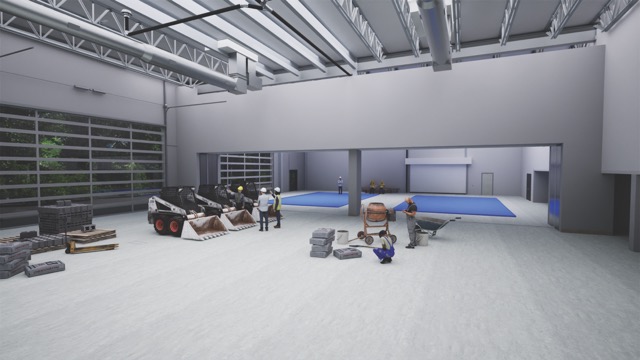 Bringing the expanded centre to life required coordinating decades of site master plans. Landscape architect Haig Seferian, principal of Seferian Design Group — who won an LO design competition over 25 years ago — led the interior and exterior master planning with the Building Committee.
While the plan has changed due to land acquisitions, the sale of lands and easements on bordering roads and highways, advancements in technology and best practices for an ever-evolving industry have also been ingrained into the vision.
“This has been underway for decades,” said Seferian. “We’ve gone through a number of different master plans before we finally reached this one, taking all those goals and dreams and now trying to encapsulate that into one overall master plan for interior and exterior.”
The expansion bids farewell to an aging greenhouse and storage Coverall, replacing them with roughly 24,000 square feet of modern infrastructure. To ensure the spaces serve every corner of the profession, the team gathered insights through focus groups spanning 10 key sectors — from garden centres and grounds management to growers, hardscape, lighting, irrigation, contractors, designers, snow and ice, and turf management.
Seferian noted how that input directly inspired the interior architecture, highlighting the need for large, two-storey classrooms to allow for year-round training. “The intent is that we can get [large] equipment and dump trucks in and out of there. So even in the winter months, students get the experience of an exterior installation, even though it’s being done inside.”
Salemi emphasized the operational flexibility of the indoor bays. “Those training areas will be multi-purpose. We want to be able to run equipment indoors. We’re going to have irrigation systems. We’re creating anchor points in the roofing system to allow for arboriculture training and climbing at heights and rope training,” he said. “Really, our imaginations are going to be the limiting factor on the types of training we’re going to be able to do in this facility.”
The design also embraces dedicated classrooms, labs, change rooms and even a soundproof recording studio.
An exterior living laboratory and showcase
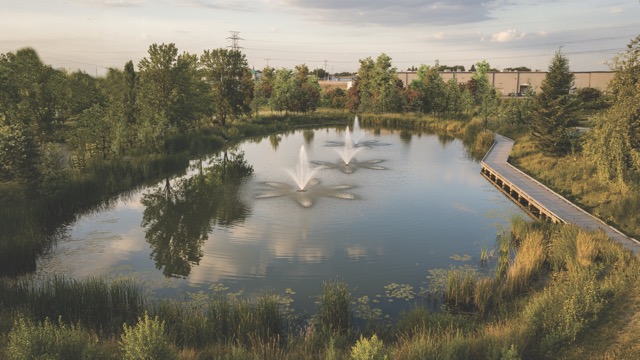 Beyond the facility walls, Seferian designed the surrounding 25-acre landscape as a functioning educational showcase, demonstrating the highest ideals of environmental stewardship and sustainable practices.
The site design weaves together permeable parking surfaces, bioswales, native pollinator habitats and structural soil cells for boulevard trees. Structural reinforcement on the roof allows for future solar arrays and green and/or blue roofs. Additionally, a re-engineered stormwater management pond featuring native wetland and lowland vegetation sits prominently along the property’s edge, facing the estimated 500,000 commuters who travel Highway 401 daily.
“This is huge. This is unlike anything else that’s out there right now. This will be one of a kind,” Seferian said.
Meeting the urgent needs of the trade
The new training centre arrives as post-secondary institutions across Ontario face program cutbacks in horticulture and landscape design. Landscape Ontario aims to fill that void through short-format workshops, flexible micro-credentials and hands-on apprenticeships.
This experiential model directly echoes DiGiovanni’s founding educational philosophy. “Landscape horticulture is a practical pursuit; skills are mastered through doing, not just sitting in a classroom,” he said. “Beyond technical skills, it will nurture entrepreneurial leadership. It will inspire youth discovering the trade, elevate apprentices, hone the skills of owners and managers, strengthen college partnerships and uplift the entire profession.”
Furthermore, the facility broadens access for individuals seeking purpose-driven careers or re-entering the workforce. Through programs like GROW, many participants come from non-traditional paths.
“When we asked [members] why they chose landscape horticulture, it’s because they wanted their work connected to a purpose,” Salemi said. “This is a trade that creates beautiful but environmentally sustainable green spaces. It contributes to people’s mental and physical health. It just has so many benefits. So when we ask people why they got connected to what we’re trying to do, it’s that purpose. It tells us we’re on the right track, we’re doing the right thing. But it also lets us know where we need to focus to help bring even more people into our community.”
The living reality
With construction advancing, DiGiovanni recently reviewed drone footage of the rising training complex, describing his immediate impression as “absolutely awesome and exciting.”
“No other landscape association on the planet possesses an asset like this,” DiGiovanni said. “In truth, very few horticultural colleges match the depth and versatility of what Landscape Ontario now offers. It is truly unique.”
Salemi extended an open invitation to the entire profession. “This is a community centre for the industry. We’re going to change the trajectory for training for the landscape trades in the province, but I also believe that we’re going to see people from the landscape trades throughout the country come and use this space to get better at what they do every day,” he said. “To all of the landscape trades professionals across Canada, this can be your home for training.”
Thirty-six years after a small group of visionary volunteers mapped their dreams across a sheet of chart paper, that blueprint is now cast in concrete, soil and glass. Soon, thanks to the generous funding provided by the MLITSD and the perseverance of LO’s leadership, staff and membership, the dream will become reality when the new training centre opens in spring 2027.
“It is a rare privilege for one generation to fulfill the vision of the pioneers who came before them,” DiGiovanni said. “Our pioneers planted that seed 36 years ago. Our current leaders have brought it into full bloom. Now, it is time for us to honour their legacy — by dreaming the next great vision for the generations to follow.
Imagine what we will build together
The LO Training Centre will be a place where the next generation of landscape professionals learn from industry leaders. Where hands-on training, new technology and fresh ideas come together, and the skills that shape the future of our industry are developed every day.
This will be the hub where the next generation of the landscape trades thrives. There are many ways large and small to help bring this vision to life — from naming a training space, supporting hands-on technology, sponsoring a section of the LO Trail or dedicating a brick, tree or other legacy feature in honour of your company, team or someone special.
Help build what comes next.
To learn more, reach out to partnerships@landscapeontario.com.
 LO acknowledges the funding support of the Government of Ontario’s Skills Development Fund – Capital Stream