 Communication, education and doing it right the first time
Interview by Karina Sinclair
Unlike many purchases, landscape clients often invest significant money into something they don’t fully understand. They rely on a landscaper’s expertise to make decisions about design, drainage, materials, plants and ongoing maintenance.
Much of this expertise is hidden beneath the surface or won’t be fully realized until years later. If clients don’t trust their contractor, they’re less likely to accept recommendations, approve budgets or give referrals.
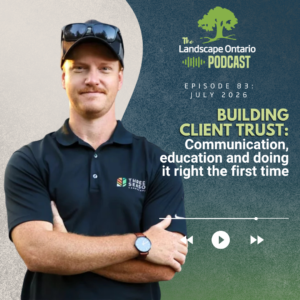
Chris Hopkins, owner of award-winning Three Seasons Landscapes and certified Ontario living wage employer, spends a lot of time not just building landscapes, but helping clients understand what goes into them, often uncovering challenges and opportunities that aren’t obvious at first glance.
What does your team do to build credibility with a client?
It starts before we even meet them. Most of our clients, especially on the private residential side, are 95 per cent referral-based. We’ve probably worked for their neighbour, a family member, or they’ve walked past and seen our work taking shape.
From the first second that we step on site for initial consultation, we’re talking about all the right things in terms of desired goals, how long are they planning to be in the house, do they have a budget range?
Then we can establish a budget range, and come up with different options for phasing the project because it’s not realistic for everybody to dump a whole bunch of money at one time into their property.
Once we have a really defined plan, we can start chipping away at the proper things in the proper sequencing. One thing that I think helps build a lot of trust is we have a really vast construction knowledge, not just landscaping knowledge. Municipal drainage codes, bylaws, setback requirements and so on.
We’re not afraid to tell people nicely that, “Hey, your ideas are great, but we don’t think that’s going to work in this backyard. Here’s reason A and B. Alternatively, we can do this or that, which might be better for this or that reason.” So having a full home health approach helps gain trust because clients are getting questions answered they didn’t even know they had to ask.
That trickles down our entire process — being fully transparent, open and flexible from start to finish. We’re trying to do things honestly and properly from stage one.
What are some issues homeowners don’t necessarily have the expertise to identify?
First and foremost is always drainage, especially because working in a lot of homes these days, properties are getting smaller and smaller. So anything you do doesn’t necessarily just affect you and the next-door neighbour. It could potentially affect the entire survey or an entire row of houses. You don’t want to go against any municipal bylaws because that could be a problem down the road.
But the other reason is when you’re thinking about drainage, you’re automatically thinking about potential grade differences in the property. I’m thinking about other costs, time and work implications like the need for retaining walls around a patio, the proper planting placement of trees and privacy and so on.
In a newer development, everybody always wants the biggest patio possible and they want privacy. They want columnar trees to block out their neighbours. So right away they want a patio that’s basically fence to fence that goes all the way back, and there’s usually a swale back there, and they want trees right back there.
Well, you can’t put the trees in the swale because the swale has to be maintained and the trees would probably die from all the moisture. So right away we’re five or so feet off the back fence line that we can’t work in, so now the trees are here. We can’t build our patio right to the fence. You need to stay at least a foot off in most municipalities, not just for drainage patterns, but also for proper granular over base under your patio and your edging. You can’t go right up to the wooden fence.
So a homeowner might have a vision pre-meeting with us of what they’re hoping for, but we sometimes need to squash that a little bit unfortunately to say, “Hey, this is the reality of the space that we can work within. Does that affect your goals? Do you want to look at some other ideas now?” And we talk through those processes.
How do you gain trust with clients who have had a bad experience with another contractor?
I’d say a significant amount of clients we work for have had a poor experience with some sort of contractor in their lifetime. Those experiences stick with them for a long time. For example, the husband and wife will be talking about a bad experience they had with a kitchen guy, and while they’re talking, I’m thinking, “Oh, okay, this must’ve been a year or two ago,” and it actually happened 30 years ago.
Even if the kitchen, for example, is still in great shape, and it looks really nice and is functional, the poor experience typically outweighs the good things that come with the end result. So for us, the process has to be as good as or better than the end result because the proof is talking to people, and they hold onto grudges for a long time.
So we try to eliminate those things for every client, especially if they’ve had a bad experience with a contractor, whether it was a year ago or three decades ago. And we try to find out what those things are so that we can really hone in on parts of the project the client really cares about.
We take extra photos. We fix things. We’ll have clients out to look at things during the project.
It’s really important to figure out those trigger points and those past poor experiences with clients so you can make sure you’re hitting those especially out of the park. Not just to develop a relationship for yourself, but to advocate for the trades and contractors in general, to try to build back a good name for all contractors hopefully.
What common misconceptions do homeowners have about landscape projects?
A big misconception is that all this stuff just happens really, really fast, and it doesn’t. It’s methodical. It’s thought out.
A lot of people love HGTV, TikToks or Instagram reels with drone footage and time lapses. Not that they’re expecting their projects to get built in 15 seconds, but they don’t understand the amount of in-ground work, the prep work, the utility trenching, permits, applications, the engineering drawings and everything involved with a large-scale project. Depending on scope, it could be six to eight months from the day you start on site to the day you’re done.
So if you’re starting these conversations in June for a project that’s going to start next March, sure, that’s lots of time to plan. But if the project’s going to take seven or eight months to build, even if we start as soon as we can in March, we’re finishing in the fall. So they’re actually not going to be enjoying it until the next year after that.
What advice would you give to other landscape pros about establishing trust with clients?
Make sure you’re taking on the right clients. Don’t always say yes to everything. Don’t be afraid to say, “Hey, I don’t think that’s a good fit for us. We’re going to respectfully pass.” There’s no shame in that.
Allow yourself a little more time to do things properly. Communicate, make sure quality is upheld and apply processes and systems. You’ll sleep better at night and you’ll have a lot more well-produced projects for really, really happy clients. That will repay itself tenfold over the next few years, for sure.

This interview was adapted from an episode of the Landscape Ontario podcast, published July 10, 2026.
To hear the entire episode, visit landscapeontario.com/podcast or search for it on your favourite podcast app.