By Patrick Falzon
Powerline safety advisor and code specialist, Electrical Safety Authority
Whether maintaining properties, installing hardscapes, pruning trees or operating heavy equipment, landscapers regularly work in environments where overhead powerlines pose a serious, and often underestimated, hazard.
According to the Electrical Safety Authority (ESA)’s Ontario Electrical Safety Report, the five‑year rolling average of overhead powerline incidents increased by 30 per cent when comparing 2015-2019 to 2020-2024. In 2024 alone, Ontario saw 307 overhead powerline contacts, the highest one‑year total in the past decade.
These statistics reflect real-world working conditions. But the good news? Overhead powerline incidents can be prevented by remembering and applying a few simple safety practices that start with looking up to identify powerlines before starting any work.
Keep yourself and your equipment at least 3 metres from overhead powerlines
The most important thing to remember is the three-metre rule. Three metres is the minimum distance to keep away from overhead powerlines, about the length of a 10-step ladder. You don’t have to touch a powerline to receive a shock — electricity can jump or “arc” to you, your ladder or any of your tools. Long-handled tools, ladders, pole saws, aerial devices and even falling branches must always remain at least three metres away. No matter what material they’re made of, carry ladders and long-handled tools horizontally when moving them on site to avoid getting too close to overhead powerlines.
Stay at least 10 metres from downed powerlines
Powerlines pulled down by fallen limbs or damaged trees may not be obvious at first glance. If something doesn’t look right, stop the job and reassess before continuing work. If there is a downed powerline, always assume it is energized and stay at least 10 metres away, which is about the length of a school bus. Do not attempt to move limbs, trees or equipment that may be touching the powerline. Call 911 immediately and wait until the local utility has shut off power and confirmed the area is safe.
Know what to do if an incident occurs
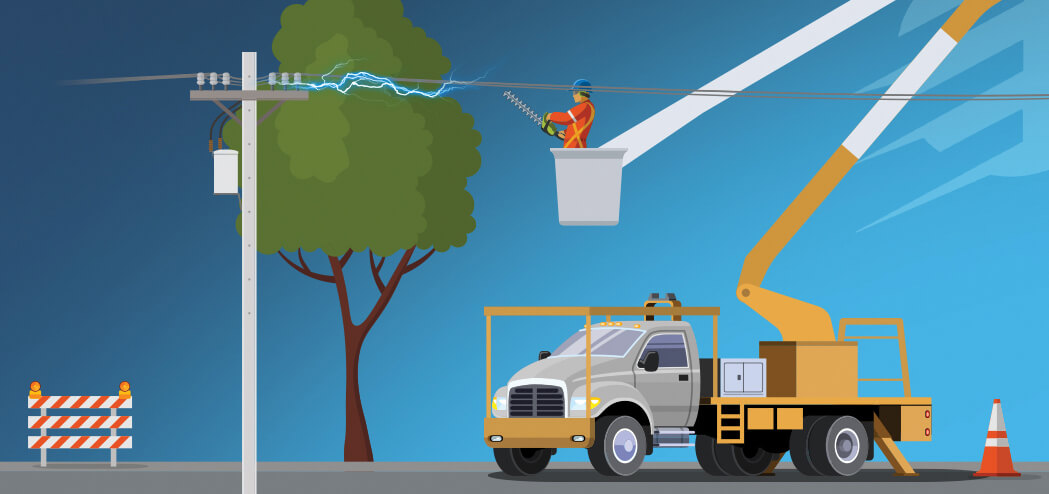
If a bucket or a lift contacts a powerline, call 911 immediately. Assume the area around the truck is energized as the ground can deliver a deadly shock. Stay in the bucket and keep everyone at least 10 metres away from you and the truck, including first responders, until the local utility has shut off the power and confirmed it is safe. No deadline is worth the risk of a serious or fatal electrical incident.
Orange coverups are for identification only
Orange coverups do not provide any protection from overhead powerlines. This dangerous misconception could be fatal for arborists. The purpose of these coverups is to mark where powerlines are. Always stay at least three metres from overhead powerlines, even when there is an orange coverup.
Peak work season is here
Electrical incidents related to overhead powerlines are most common during the same months that landscapers are busiest. ESA data shows 61 per cent of electrical fatalities in Ontario occur between June and September. Routine tasks such as trimming trees, installing fences or irrigation, loading dump trucks or working near property edges can quickly become high risk when overhead lines aren’t identified or accounted for.