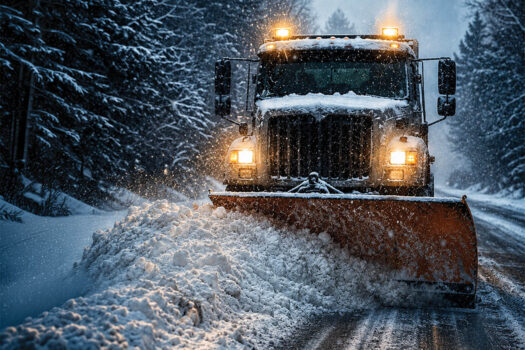
Systems that create calm when the season delivers its worst
 Commercial snow has a way of exposing the truth about a company. In the landscape season, weak planning leads to delays, rework, confusion and lost margin. In winter, the stakes are even higher. There is less room for error, more pressure on the team, greater liability exposure and clients depend on your operation to keep their business safe, accessible and functioning.
Snow and ice management is not just about clearing snow. It is an essential service built on strong planning, disciplined routing, clear communication, solid documentation, performance tracking and trust.
Snow season is won long before it starts
For companies offering commercial snow and ice management, the work begins long before the first storm. One of the biggest mistakes in snow is treating winter like an event instead of a season. By the time the season starts, the real planning should already be done.
Every commercial property has its own risk points: from entrances and loading docks to fire routes, sidewalks, drainage areas, emergency exits, catch basins, visibility concerns and snow storage limitations. This is where a proper snow plan becomes essential. By the first snow event, site priorities, scope, risk areas and client expectations should already be established.
An effective snow plan should make the work clear before the operator arrives on site. It defines the sequence, the priorities, the risk areas and what good execution looks like. That is where planning becomes production.
Professional snow operations depend on more than good equipment. They require site-specific planning, trained operators, reliable backup equipment, weather monitoring, service records and clear response protocols. These are the systems that turn winter preparation into reliable execution.
Efficiency is built into the route
In snow, route density is not just an operational detail; it’s a business strategy.
A route may look manageable on a map, but if the accounts are spread too widely, performance can break down quickly during a major storm. Every extra minute of travel affects the operation: from service timing and operator fatigue to fuel cost, equipment wear, profitability and client confidence.
Limiting route capacity and concentrating route loads is not about taking on less work. It is about protecting response time, service quality and profitability. When routes are built properly, snow equipment spends more time producing revenue and less time travelling between poorly grouped accounts.
Profitability in snow is driven by productive time. Whether you call it revenue per hour, revenue per outing or production efficiency, the principle is the same — the more time your equipment spends servicing clients, the stronger your operation becomes. A snow contract may look profitable on paper, but the truth shows up after equipment costs, material use, labour, travel time, callbacks and overhead are accounted for.
Salt and abrasives should be managed with the same discipline. Track material use by site, event, condition and outcome. Over-application can waste money, damage surfaces and is environmentally irresponsible. Under-application creates safety and liability concerns. The most disciplined snow operations treat ice control as a managed process supported by weather monitoring, application history, field reporting and client communication.
Ice control, abrasives and snow hauling can become effective profit centres — especially when they are properly managed, authorized, documented and billed. They are not extras. They are part of responsible property management and a real opportunity to improve winter margins.
Communication creates confidence
After more than 40 years in commercial snow and ice management, one lesson stands above many others. We refer to it as the 3 C’s of snow service: communicate, communicate, communicate.
Commercial clients worry about access, staff safety, customer traffic, deliveries, tenants, liability and the financial impact if their premises are not fully functional. During a storm, uncertainty builds quickly. They want confirmation the site is being monitored, crews are active, priorities are understood and changing conditions are being managed.
That’s why communication cannot be an afterthought. Pre-storm updates, live dispatch, client portals, snow lines, GPS visibility, salt application reports and post-operation updates all help keep clients informed. Around-the-clock patrols and structured service concern tracking also help manage sites proactively instead of waiting for the phone to ring.
For broader updates, email notices, portals and even social media can reinforce communication, but site-specific concerns still require a clear dispatch and reporting process. If there is a slowdown, then say so. If a route is delayed, explain it. If conditions are changing, update the client before they have to chase you.
In commercial snow, peace of mind is not a slogan. It is what clients are really buying and what they expect you to deliver.
Documentation drives improvement
In the commercial snow profession, risk is part of the responsibility. Slip-and-fall exposure, property damage concerns, unclear expectations and service disputes can all become serious issues if records are weak.
Documentation protects the contractor, client and the team. Good records create a clear account of what happened, including weather logs, GPS data, service times, material applications, patrol notes, client concerns and post-event reports. Few records speak as clearly as a photograph. Photos and short videos taken before, during and after service are especially valuable. If damage existed before the storm, document it. If a hazard is found, report it. If a client concern comes in, record it.
Good documentation is not only useful when questions are asked later, it can also improve the operation. Every service concern or incident should become a learning opportunity. If the same issue repeats, it is rarely just a client problem. It is usually a process problem waiting to be fixed.
Strong systems create calm inside the company and reduce stress on the team. Operators make better decisions when the route, scope, site priorities, reporting expectations and communication process are clear before the storm begins. That clarity reduces decision fatigue, improves accountability and helps the team perform under pressure.
After each significant event, review what happened. Where did equipment lose time? Where did material use exceed expectations? Which sites generated concerns? Which routes need adjustment? That post-event review is where snow operations improve from one storm to the next.
Commercial snow and ice management is seasonal, intense and certainly not for the faint of heart. But the discipline it demands should influence how we run the rest of our companies and divisions. It teaches planning before pressure, communication before complaint, documentation before dispute and systems before heroics.
When we provide true peace of mind to our clients, we do more than clear snow. We build confidence, trust and the kind of relationships that survive even the toughest storms.
As Dwight D. Eisenhower once said, “Plans are worthless, but planning is everything.”
Glenn Curtis
Owner
Plantenance Landscape Group
Glenn Curtis is a Certified LeanScaper Advisor who helps landscape professionals implement practical systems that drive clarity, profitability and sustainable growth. He is also co-founder and president of Plantenance Landscape Group and Design Plantenance, an award-winning firm creating exceptional outdoor environments for more than 45 years.