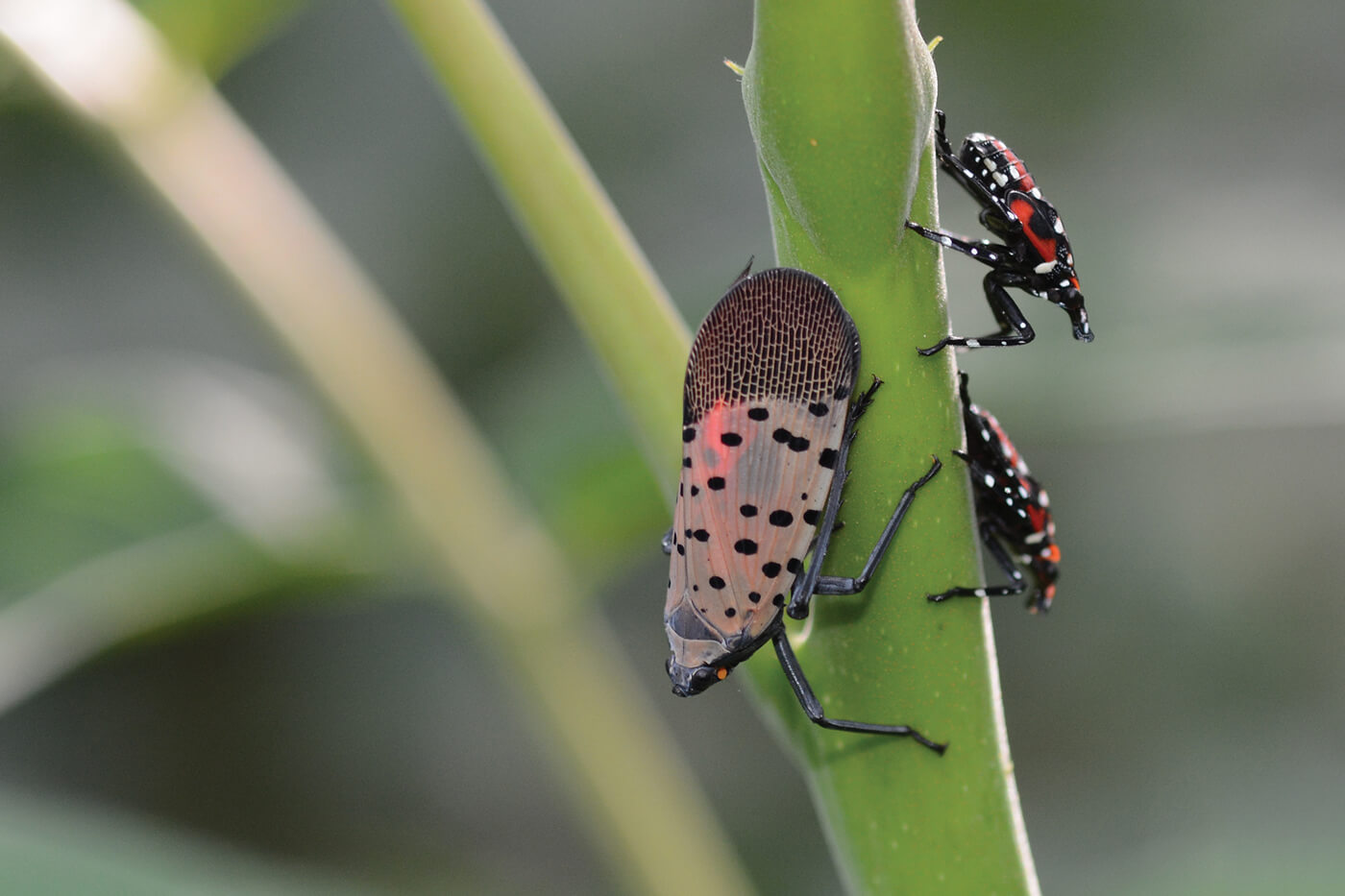
Be on the lookout for Spotted Lanternfly. Pictured here is the pest at the nymph stage (right) and adult stage (left).
By Ree Laforet
Spotted lanternfly or SLF (Lycorma delicatula) is an invasive insect that first arrived in 2012 in Pennsylvania, Ohio. Since then, it has spread to at least 18 states in the U.S., despite efforts over the past decade to slow the spread. With infestations in neighbouring states such as Ohio, Michigan and New York, its spread into Ontario is not a question of “if” so much as “when.”
Spotted lanternfly adults are quite distinctive, large insects that can feed on over 100 host plants. Adults can hop or fly and use their long, straw-like mouthparts to pierce into the trunk and branches of trees and vines to feed on sugary sap. Tree-of-Heaven (Ailanthus altissima), grapes (Vitis ssp. both wild and cultivated) and black walnut (Juglans nigra) are SLF’s preference in the landscape, but they can feed on most deciduous and herbaceous plants in their path. When it comes time for SLF to lay their eggs in the fall, they create thumb-length, putty-like masses, and will lay them on whatever’s on-hand: tree trunks, pots, landscaping stones, skids, shipping containers and even wheel wells.
While SLF feeds on many different plant species, it’s only been known to kill Tree-of-Heaven and grapes. For most landscape plants, SLF is not a “plant-killer” but a “plant-stressor” much like aphids. As a sap-feeder, SLF excretes copious amounts of sticky honeydew that rains down and coats everything beneath where it’s feeding. If that isn’t unpleasant enough, the sticky substance quickly grows black, sooty mold — turning surfaces grimy looking. It’s a major “ick factor” and a big reason SLF has become such a public nuisance across the U.S.
To mitigate SLF’s anticipated impacts to our wine, nursery and forestry industries, we need everyone’s help to recognize and report this invasive pest to give time for these sectors to prepare. Plants imported from infested U.S. states represent a potential pathway for bringing SLF to Canada, but since eggs can be laid on nearly any surface and the nymphs and adults are excellent hitchhikers, all conveyances coming through infested regions should be thoroughly checked at time of arrival: plants, pallets, hard goods, wrapping material and the vehicle itself. All vehicles and marine vessels arriving at Ontario and Québec ports of entry from the U.S. should also be checked for all life stages of SLF.
Reporting any suspected finds of SLF remains incredibly important to slow the introduction and spread. If you suspect an insect is SLF, report your find directly to the Canadian Food Inspection Agency (CFIA). This is a regulated pest and the CFIA has not yet confirmed any established populations in Canada. CFIA is the agency who ultimately confirms the insect report and they provide direction on actions following a sighting. When making a pest report to CFIA, be sure to include the following:
- Exact location where you found it.
- How many you found.
- If it was alive or dead.
- Include clear photos or videos.
- Collected samples (if possible).
So, keep your eyes open this summer and put the “Spot” in “Spotted lanternfly.”
Report all suspected sightings and get accurate information on SLF:
 https://inspection.canada.ca/en/plant-health/invasive-pests-and-plants/insects/spotted-lanternfly